
Most people spend their entire lives chasing money the same way: trading time for dollars.
You wake up, go to work, collect a paycheck, pay bills, and repeat the cycle for 30 or 40 years. It works — until it doesn’t. A layoff happens. Inflation rises. Retirement gets closer. Suddenly, relying only on earned income starts feeling risky.
That is exactly why understanding passive income vs active income financial freedom matters.
The difference between people who stay trapped financially and people who build lasting wealth often comes down to one simple concept:
Are you working for money, or is money working for you?
In this guide, we’ll break down the real differences between active and passive income, why wealthy investors prioritize cash-flowing assets, and how ordinary people can begin building long-term financial independence through dividend stocks, REITs, and other income-producing investments.
What Is Active Income?
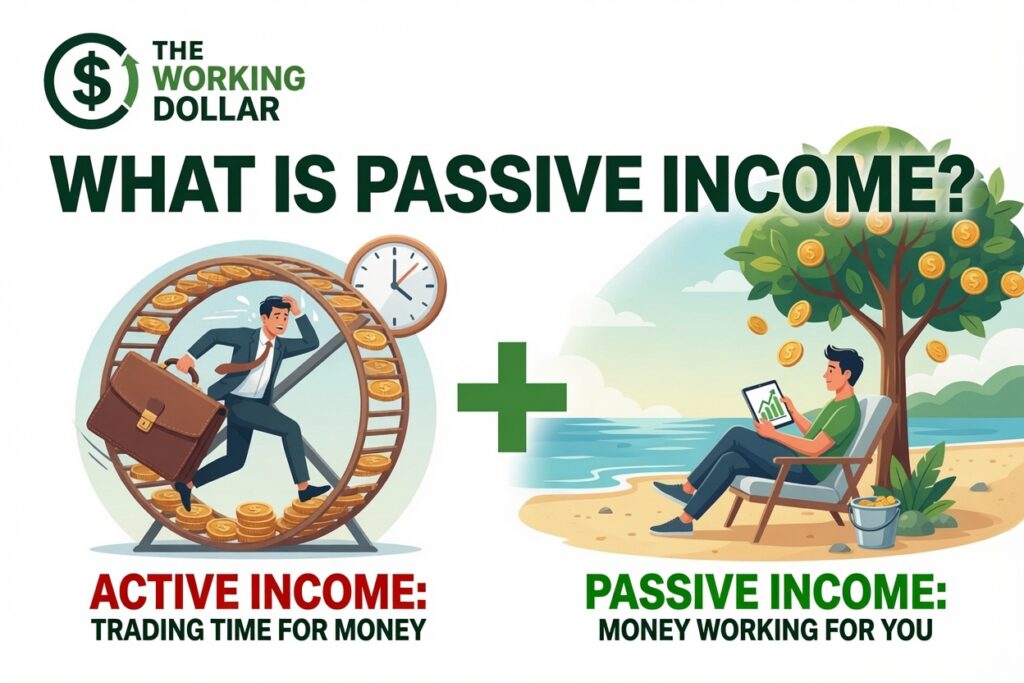
Active income is the most common type of income in the world.
It refers to money you earn by actively trading your time, skills, or labor.
Some common active income examples include:
- Working a traditional 9–5 job
- Freelancing
- Consulting
- Running a service-based business
- Hourly wage employment
- Salaried corporate jobs
- Driving for delivery apps or rideshare companies
The biggest downside?
If you stop working, the money stops coming.
This is why millions of people spend decades earning good salaries yet never build true financial security.
Your income depends entirely on your ability to continue producing labor.
What Is Passive Income?
Passive income works differently.
Instead of trading time directly for money, you build or buy assets that generate recurring cash flow.
Examples include:
- Dividend-paying stocks
- Real estate investment trusts (REITs)
- Rental properties
- High-yield savings accounts (HYSAs)
- Bonds
- Digital products
- Royalties
- Businesses that run without daily involvement
Unlike active income, passive income allows you to earn money continuously after the initial work has been done.
If structured properly, passive income can eventually cover all living expenses.
That is where financial freedom begins.
Passive Income vs Active Income Financial Freedom Example
Imagine two people for passive income vs active income:
Person A
Works a job earning $80,000 annually.
The moment they stop working, income stops.
Person B
Owns a portfolio generating:
- $2,500 monthly in dividend income
- $1,500 monthly from REIT distributions
- $500 monthly from a HYSA
- $1,500 monthly from rental property cash flow
Total monthly income:
$6,000 per month without actively working.
That is a practical passive income vs active income financial freedom example.
The second person has built income-producing assets.
They no longer depend entirely on labor.
This is how wealth compounds over time.
Is Passive Income Better Than Active Income?
This question comes up constantly.
So, is passive income better than active income?
The answer is nuanced.
Passive income is not necessarily better at the beginning.
You typically need active income first.
Your job, business, or freelance work provides the capital needed to buy assets.
But over the long term?
Passive income wins.
Here’s why.
Active Income Limitations
- Limited by time
- Limited by energy
- Subject to layoffs
- Often heavily taxed
- Requires continuous labor
Passive Income Advantages
- Money continues flowing without constant effort
- Scalable over time
- Less dependence on employment
- Allows greater flexibility
- Builds financial independence faster
The smartest approach is not choosing one or the other.
It is using active income to build passive income.
That strategy creates freedom.
Passive Income vs Active Income Tax Differences
Many investors ignore taxes.
That is a mistake.
Understanding passive income vs active income tax treatment can dramatically affect long-term wealth.
In most countries, active income is taxed at ordinary income tax rates.
That often means higher taxation.
Examples:
- Salary
- Wages
- Freelance work
- Consulting income
Passive income can sometimes receive more favorable treatment.
Examples include:
- Qualified dividends
- Long-term capital gains
- Certain REIT tax structures
- Tax-advantaged retirement accounts
This is one reason wealthy investors shift focus toward assets.
Understanding passive income vs active income financial freedom tax implications can help preserve more capital over time.
Always review tax laws in your country or speak with a licensed tax professional.
Passive Income vs Residual Income
People often confuse these terms.
So what is the difference between passive income vs residual income?
Passive Income
Income generated from assets requiring little ongoing work.
Examples:
- Dividend stocks
- Bonds
- Rental properties
- Savings account interest
Residual Income
Income earned repeatedly from work completed once.
Examples:
- Book royalties
- Online courses
- Affiliate commissions
- Subscription products
- Software memberships
The distinction matters less than the principle.
Both allow you to earn without continuously trading time for money.
And both can help accelerate financial freedom.
What Creates 90% Of Millionaires?
A surprising number of wealthy people did not become rich through salary alone.
So what creates 90% of millionaires?
Ownership.
Most millionaires build wealth through assets.
Historically, wealth creation often comes from:
Real Estate
Rental properties and appreciating property values create equity over decades.
Stock Market Investing
Long-term investing in dividend stocks and broad market index funds allows capital to compound.
Business Ownership
Businesses create scalable income independent of direct labor.
Dividend Investing
Companies paying reliable dividends provide recurring cash flow while allowing capital appreciation.
REIT Investing
REITs allow investors to earn income from commercial real estate without buying physical property.
The pattern becomes obvious.
Wealth rarely comes from labor alone.
It comes from owning assets.
What Is The 3 6 9 Rule Of Money?
The 3 6 9 rule of money is a simple framework many people use when building financial security.
3 Months Emergency Fund
Save enough cash to cover three months of expenses.
This creates short-term security.
6 Months Financial Cushion
Build six months of living expenses.
This protects against unemployment or emergencies.
9 Streams Of Income
The long-term goal is diversification.
Relying on one paycheck is risky.
Many financially successful people eventually build multiple income streams such as:
- Dividend income
- REIT income
- HYSA interest
- Rental income
- Business profits
- Side hustle income
- Capital gains
- Bond income
- Digital product sales
Diversification creates resilience.
How Can I Make $10,000 A Month In Passive Income?
This is where strategy matters.
People often ask:
How can I make $10,000 a month in passive income?
Let’s break it down.
Assume you invest in dividend stocks averaging a 4% yield.
To generate $120,000 annually:
You would need roughly:
$3 million invested
But combining multiple assets changes the equation.
Example portfolio:
Dividend Stocks
$800,000 portfolio at 4.5%
Annual income:
$36,000
REIT Portfolio
$500,000 portfolio at 6%
Annual income:
$30,000
HYSA Savings
$250,000 at 4%
Annual income:
$10,000
Rental Property
Two rental properties generating $2,000 monthly cash flow each
Annual income:
$48,000
Total annual passive income:
$124,000 per year
Approximately:
$10,300 monthly
This is why long-term investing matters.
Financial freedom is not built overnight.
It is built asset by asset.
Passive Income vs Active Income Financial Freedom Calculator
One useful exercise is creating a simple income freedom calculation.
Take your monthly expenses.
Example:
Monthly expenses = $4,000
Multiply by 12.
Annual expenses = $48,000
Now divide by expected investment yield.
If portfolio yield is 4%:
$48,000 ÷ 0.04
Required portfolio:
$1.2 million
This becomes your freedom number.
A simple passive income vs active income financial freedom calculator helps visualize the amount of capital needed before work becomes optional.
Final Thoughts
Most people spend decades focusing entirely on earned income.
But financial freedom rarely comes from earning alone.
It comes from ownership.
Your paycheck can support your lifestyle.
But assets create independence.
The goal is simple:
Use active income today to build passive income tomorrow.
Dividend stocks.
REITs.
High-yield savings accounts.
Income-producing investments.
These are the tools that gradually shift you from worker to owner.
And over time?
That shift changes everything.
Want To Start Building Passive Income The Smart Way?
Get our FREE ebook: 100 Dividend Stocks Ranked By Yield And Safety — yours instantly when you subscribe.
If you’re serious about building long-term wealth, generating reliable cash flow, and creating financial freedom through investing, this guide gives you a head start with carefully selected dividend opportunities built for income-focused investors.
Start building income that works for you — not the other way around.
And stop the passive income vs active income debate.